What do you sacrifice when you trade convenience for safety, or gas efficiency for auditability? For DeFi power users in the US who routinely hop between dApps, chains, and complex smart‑contract interactions, those trade-offs matter more than brand loyalty. This piece compares Rabby — a simulation-first, multi‑chain wallet — against common alternatives and gives a decision-useful framework: when Rabby is the right tool, when another wallet may be better, and how to set it up without undermining the protections you signed up for.
Start from mechanism: wallets do three things for you — custody keys, present a UI for dApp interactions, and mediate transactions. Differences between wallets are largely differences in how those three roles are implemented and which risks they prioritize. Rabby’s design choices highlight one clear philosophy: prevent dangerous human errors before signatures leave your browser. That orientation changes which risks you reduce and which remain.
How Rabby works, mechanically — and why simulation matters
Rabby is a non-custodial wallet built by DeBank and distributed across Chrome/Chromium extensions, mobile (iOS/Android), and desktop (Windows/macOS). Its open-source MIT codebase means independent auditors and security researchers can inspect implementation details; that transparency is a valuable control but not an automatic guarantee of safety.
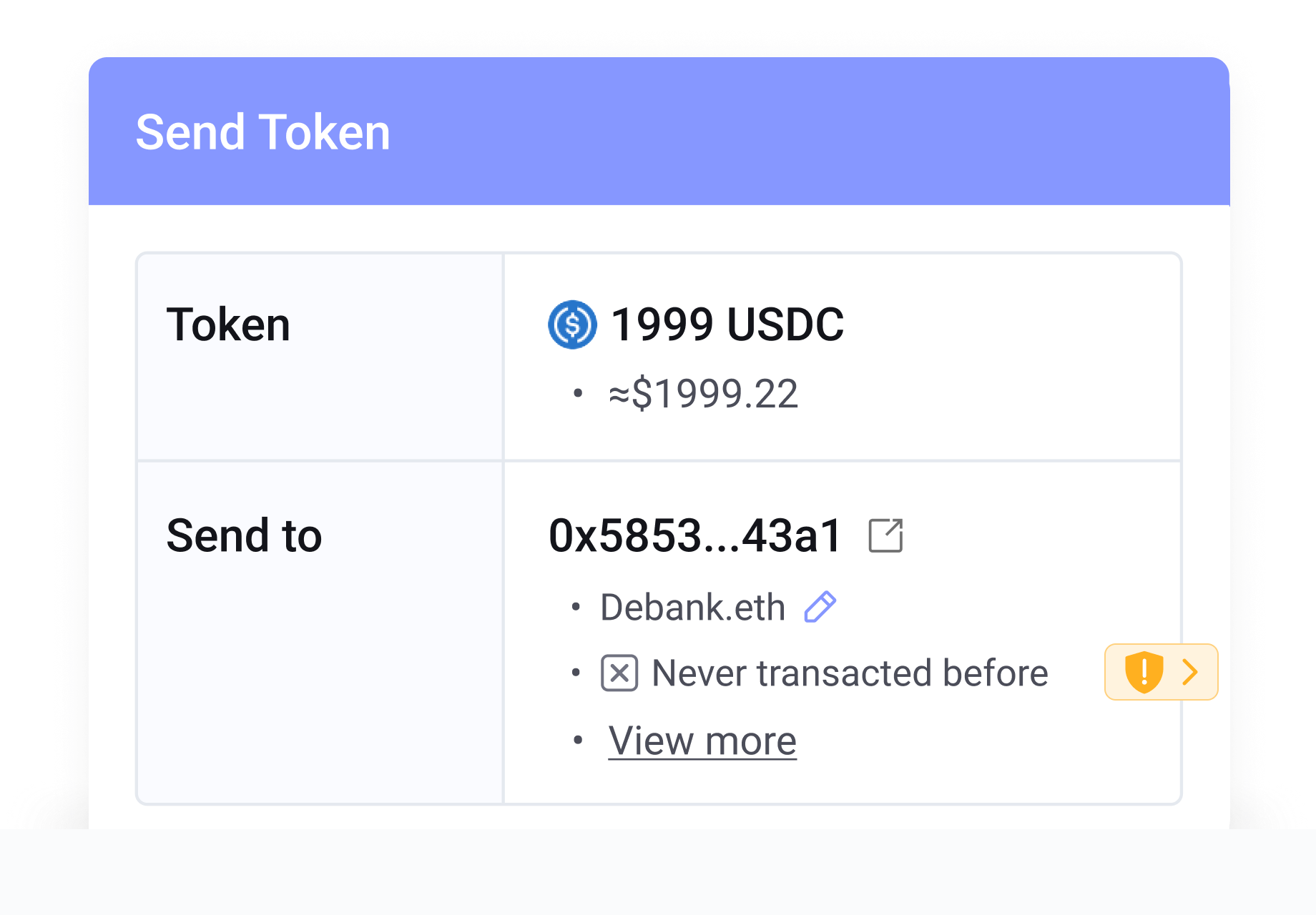
The wallet’s signature feature for power users is transaction simulation. Before you sign, Rabby runs the proposed transaction locally and shows the estimated token balance deltas and fees. In mechanism terms, this creates an independent check between the raw transaction data (what the dApp asks you to sign) and the human-readable outcome (how your balances will change). That closes many blind‑signing attack vectors that have cost users funds in the past.
Rabby also embeds a pre‑transaction risk scanner that flags known hacked contracts, suspicious approval requests, and invalid recipient addresses. Combined with a native approval revocation tool, the wallet aims to reduce long‑term exposure from token approvals — a common and underappreciated source of losses.
Side-by-side: Rabby versus MetaMask and Coinbase Wallet
For a tight decision framework, compare three tension axes: security posture (prevention vs. recovery), protocol reach (number of chains and dApp UX), and institutional features (multi‑sig & custody integration).
Security posture — Rabby: prevention through simulation, approval revocation, and pre‑checks. MetaMask: a dominant interface with many integrations but historically less emphasis on in‑wallet simulation by default. Coinbase Wallet: easier fiat on‑ramp through Coinbase ecosystem, more consumer‑oriented protections but less simulation depth. If your threat model is malicious smart contracts or socially engineered signing prompts, Rabby’s simulation materially reduces that risk.
Protocol reach — Rabby supports 90+ EVM chains, automatic network switching, and cross‑chain gas top‑up. MetaMask supports most EVMs too, and has broader third‑party support simply because of market share. Coinbase Wallet trades some breadth for simpler fiat rails. If you actively use Arbitrum, Optimism, Polygon, Avalanche and niche chains, Rabby’s network list and automatic switching are strong conveniences.
Institutional features — Rabby integrates with Gnosis Safe, Fireblocks and similar custody solutions, which matters if you operate a DAO treasury or an LLC. MetaMask can be paired with hardware keys and enterprise flows but lacks the same integrated multi‑sig workflow. Coinbase targets retail customers and centralized exchange tie‑ins instead. For an institutional or multi‑sign setup, Rabby’s ecosystem is a feature, not an add‑on.
Where Rabby breaks or is incomplete — realistic limits to plan around
No wallet is a panacea. Rabby lacks a built‑in fiat on‑ramp and does not provide native in‑wallet staking. That means US users who value one-click fiat purchases or want to stake from the same UI will need external services. The lack of in‑wallet staking isn’t a security flaw; rather, it’s a design scope decision that keeps the codebase narrower — and audit surfaces smaller — but it imposes an operational cost: more context switching and potentially more off‑platform KYC exposure.
Past incidents matter. In 2022 a smart contract tied to Rabby Swap was exploited for about $190k. The team froze the contract, reimbursed users, and beefed up audits. The useful lesson here is structural: wallet teams can control the wallet code, but dApp contracts — even those branded or integrated into the ecosystem — are separate security domains. Rabby’s simulation and pre‑checks mitigate contract risks but don’t eliminate supply‑chain threats or novel zero‑day exploits.
Hardware wallet support is robust: Ledger, Trezor, Keystone, and others are compatible. That’s important because the strongest control against remote key exfiltration is an offline private key secured on a hardware device. Use Rabby as the UX layer and pair it with a hardware wallet for signing high‑value transactions; it combines Rabby’s simulation with hardware key immutability.
Practical setup and operational heuristics for US DeFi power users
If you decide to install the extension, follow a layered process: 1) install the official extension on a Chromium-based browser (Chrome, Brave, Edge) or use the desktop app; 2) import or create a wallet and immediately connect a hardware device for any high-value accounts; 3) configure approval revocation and run a baseline revocation sweep; 4) enable automatic network switching and test cross‑chain gas top‑up on a small value transfer.
One misconception to correct: simulation is not magic. It estimates state changes based on current on‑chain data. If a protocol executes different logic later (for example, because of an oracle update within the same block or MEV reordering), the simulation may diverge. Rabby lowers the probability of blind‑sign losses, but it does not make on‑chain execution deterministic from the UI. Treat simulation as a probabilistic safety net, not a formal verifier.
Another heuristic: reserve a “hot” account with small balances for routine dApp interactions and keep large positions in a hardware-backed or multi‑sig vault. Rabby integrates with multi‑sig solutions, so you can use it to orchestrate transactions while keeping long‑term custody with stronger controls.
If you want to try Rabby, their extension is discoverable and installable as a browser add-on; for convenience, here is the official extension page: rabby wallet extension.
Decision heuristics — a one‑line rule for choosing Rabby
Choose Rabby if your primary risk is blind signing and contract-level surprises, you use many EVM chains, and you value integrated tools for approval revocation and multi‑sig workflows. Choose a MetaMask-centric flow if you need the widest third‑party integration and are willing to add additional tooling for pre‑transaction safety. Choose Coinbase Wallet if you prioritize fiat on‑ramps and on‑ramp simplicity over the simulation-first security posture.
FAQ
Is Rabby safe enough for large balances?
“Safe” depends on your threat model. Rabby reduces human error by simulating transactions and flagging risky approvals, which materially lowers exposure to blind‑sign exploits. But for very large balances you should pair Rabby with hardware wallets and/or multi‑sig custody (Gnosis Safe, Fireblocks) because those add offline key protection and institutional approvals that a single-extension can’t provide.
Can Rabby buy crypto directly with USD using a card or bank?
No — Rabby does not include a built‑in fiat on‑ramp. US users will need to purchase tokens through an exchange or a third‑party service and then transfer them into Rabby. That extra step is a UX inconvenience but also reduces surface area for wallet code that would have to integrate KYC and payment rails.
How reliable is the transaction simulation — can it be fooled?
Simulations rely on current on‑chain state and heuristics. They catch many classes of malicious or mistaken transactions, but they can be imperfect when protocols depend on off‑chain data, fast-moving oracle changes, or complex MEV behavior. Use simulations as one control among others (hardware keys, small test transactions, multi‑sig) rather than sole protection.
Does Rabby work with hardware wallets?
Yes. Rabby supports Ledger, Trezor, Keystone, CoolWallet and several others. Pairing Rabby’s UX and simulation with a hardware signer gives a strong combined posture: human-readable checks before the hardware signs an irreversible transaction.
Bottom line: Rabby changes the cost-benefit calculus for active DeFi users by shifting effort from post‑loss recovery to pre‑sign prevention. It isn’t a substitute for careful custody practices, but when combined with hardware devices and multi‑sig configurations it becomes a powerful operational layer for serious users who move across many EVM chains. Watch the space for continued improvements in simulation fidelity and broader institutional integrations; those are the features most likely to raise the practical security floor for everyone.
Leave a Reply